Pet Store

Pet news, tips, entertainment and opinions from VetLocator.com

FDA – 10 Questions to Ask Your Vet About Medication for Your Pet

June 23rd, 2010
Kevin Fitzgerald, a veterinarian at the Alamed...
Image via Wikipedia

The following is good advice from the FDA on questions you should ask when your pet is prescribed medication:

To prevent or treat an illness in your pet, your veterinarian may prescribe a medication.

Understanding important information about the medication and how to treat your pet can help your animal’s recovery or continued good health.

“Just as you would talk to your doctor about a medicine prescribed for you or your children, you should talk to your veterinarian about your pet’s medications,” says Bernadette Dunham, D.V.M., Ph.D., director of the Center for Veterinary Medicine at the Food and Drug Administration (FDA). “And if you have any questions after you leave the animal clinic, don’t be afraid to contact and follow-up with your veterinarian.”

Here are 10 questions you should ask your vet when medication is prescribed.

1. Why has my pet been prescribed this medication and how long do I need to give it?

Your veterinarian can tell you what the medication is expected to do for your pet and how many days to give it.

2. How do I give the medication to my pet? Should it be given with food?

Your pet may have fewer side effects, like an upset stomach, from some drugs if they are taken with food. Other medications are best to give on an empty stomach.

3. How often should the medication be given and how much should I give each time? If it is a liquid, should I shake it first?

Giving the right dose at the right time of the day will help your pet get better more quickly.

4. How do I store the medication?

Some medications should be stored in a cool, dry place. Others may require refrigeration.

5. What should I do if my pet vomits or spits out the medication?

Your veterinarian may want to hear from you if your pet vomits. You may be told to stop giving the drug or to switch your pet to another drug.

6. If I forget to give the medication, should I give it as soon as I remember or wait until the next scheduled dose? What if I accidentally give too much?

Giving your pet too much of certain medications can cause serious side effects. You’ll want to know if giving too much is a cause for concern and a trip to the animal emergency room.

7. Should I finish giving all of the medication, even if my pet seems to be back to normal?

Some medications, such as antibiotics, should be given for a certain length of time, even if your pet is feeling better.

8. Could this medication interact with other medications my pet is taking?

Always tell your veterinarian what other medications your pet is taking, including prescription medications, over-the-counter medicines, and herbs or other dietary supplements. You may want to write these down and take the list with you to the vet’s office.

9. What reactions should I watch for, and what should I do if I see any side effects?

Your veterinarian can tell you if a reaction is normal or if it signals a serious problem. You may be asked to call your vet immediately if certain side effects occur.

FDA encourages veterinarians and animal owners to report serious side effects from medications to FDA’s Center for Veterinary Medicine at 1-800-FDA-VETS. For a copy of the reporting form and more information on how to report problems, visit the Web site, How to Report An Adverse Drug Experience4.

10. When should I bring my pet back for a recheck? Will you be calling me to check on my pet’s progress, or should I call you?

Your vet may want to examine your pet or perform laboratory tests to make sure the medication is working as it should.

———–

This is good advice to follow.  Just as in humans, mixing medications and doing something that is ‘off label’ (not following instructions, etc.) can compromise your pet’s health.

Enhanced by Zemanta

Afraid you might be prone to prostate cancer? Get a dog

June 2nd, 2010
Belgian Malinois
Image via Wikipedia

French study says dogs can detect prostate cancer

There is new research that suggests dogs can sniff out signs of prostate cancer in human urine.

The lead author of this latest study said the findings are promising and could lead to better cancer-sensing technology.

“The dogs are certainly recognizing the odor of a molecule that is produced by cancer cells,” said French researcher Jean-Nicolas Cornu, who works at Hospital Tenon in Paris.

The problem, he said, is that “we do not know what this molecule is, and the dog cannot tell us.”

Still, the report could represent a significant development since cancer often goes undetected until it is too late to treat.

The detection of prostate cancer has been particularly controversial. Some researchers think many patients are treated unnecessarily because existing tests of prostate-specific antigen (PSA) aren’t accurate enough and fail to distinguish between dangerous and harmless cancers.

Urine tests can turn up signs of prostate cancer, Cornu said, but miss some cases. Some types of molecules give a distinct odor to urine, “but today there is no means to screen odors from urine and separate them,” he said, and no way to link them to cancer.

Enter the dog, whose powers of smell are far greater than those of humans.

For this study, two researchers spent a year training a Belgian Malinois shepherd, a breed already used to detect drugs and bombs.

The dog was trained to differentiate between urine samples from men with prostate cancer and men without. Ultimately, researchers placed groups of five urine samples in front of the dog to see if it could identify the sole sample from a man with prostate cancer.

The dog correctly classified 63 out of 66 specimens.

If the findings hold up in other studies, they’ll be “pretty impressive,” said urologist Dr. Anthony Y. Smith, who was to moderate a discussion on the findings Tuesday at the American Urological Association annual meeting in San Francisco.

Skeptical researchers are concerned about factors that could throw off the results, said Smith, chief of urology at the University of New Mexico. Among other things, scientists wonder if the animals used in such studies pick up on subconscious signals from researchers.

Still, in this study, it’s hard to imagine anything “other than the dogs somehow being able to smell something that we don’t smell,” Smith said.

If these findings are valid, they could lead to the development of more accurate tests that don’t require unnecessary biopsies, Smith said.

The next steps are to determine precisely what the dogs are sniffing and to develop an “electronic nose” to detect it, Cornu said. Other dogs are already being trained, he said.

Could doctors and hospitals employ dogs and researchers to detect prostate cancer? Cornu said that’s possible, but it could cost as much as hiring two full-time scientists.

This is a story from HealthDay, a service of ScoutNews, LLC.
Enhanced by Zemanta

A unique oil spill cleanup solution

May 23rd, 2010
BP Gulf Oil Spill, 5.20.2010, @40,000 feet.
Image by zphone via Flickr

There have been many proposed helpful solutions to help clean up the oil that is spreading across the Gulf including oil booms, fires, dispersing agents and several others.

One of the more unique solutions come from hair salons collecting human hair from their hair cuts to be used to soak up the oil.  Now a Dallas pet groomer is doing the same with pet hair.

The Petropolitan is collecting an incredible amount of pet hair that will be shipped south on June 10 to be made into a hair boom which will be placed on shorelines to collect oil that makes it to the shore.

“A hair boom is a piece of pantyhose shoved full of about 20 pounds of pet and human hair. According to Petropolitan co-owner Chris Watts, 20 pounds of pet hair can collect 200 pounds of oil. The bags of hair will be shipped to representatives of the non-profit Matter of Trust, who have been given approval by the Coast Guard to donate booms for the coast.”

How to Make a Hair Boom

Unfortunately, engineers working to clean up the oil spill just announced they will not use hair booms in their efforts as they feel their commercial booms work better.


Reblog this post [with Zemanta]

To wrap up Dog Bite prevention week – help request from mailmen across America

May 23rd, 2010

Dog bites are one of the hazards of being a postal carrier is the risk of being bitten by a dog.

Here are some tips from Katu.com:

“To spread the word that dog bites are preventable, the Postal Service is working with the American Academy of Pediatrics, American Veterinary Medical Association and the American Society of Plastic Surgeons. Other organizations include the American Society of Maxillofacial Surgeons, the American Society for Reconstructive Microsurgery and Prevent The Bite. The Verterinary Medical Association’s brochure, “What you should know about dog bite prevention,” offers tips on how to avoid being bitten, what dog owners can do to prevent their dogs from biting and how to treat dog bites.

Tips include picking a dog that is a good match for your home, socializing a pet and avoiding aggressive games. Meanwhile, the Postal Service offers these tips for avoiding a bite:

  • Don’t run past a dog. The dog’s natural instinct is to chase and catch prey.
  • If a dog threatens you, don’t scream. Avoid eye contact. Try to remain motionless until the dog leaves, then back away slowly until the dog is out of sight.
  • Don’t approach a strange dog, especially one that’s tethered or confined.
  • While letter carriers are discouraged from petting animals, people who choose to pet dogs should always let a dog see and sniff them before petting the animal.
  • If you believe a dog is about to attack you, try to place something between yourself and the dog, such as a backpack or a bicycle.

[Dog Bites can be prevented]

It’s good to be familiar with what you can do to prevent being bitten by a dog and how you can help our mail carriers remain safe from bites as well.

Reblog this post [with Zemanta]

Pet Freebie: Arm & Hammer offers free cat id tag with purchase

May 21st, 2010

Arm & Hammer

Arm & Hammer

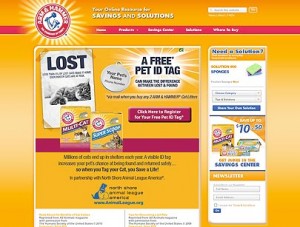
Arm & Hammer is partnering with North Shore Animal League America (NSALA) to educate cat owners about the importance of pet identification tags.

To support the collaboration, Arm & Hammer has launched an integrated marketing campaign with the tagline: “Tag a Cat, Save a Life.” Ads will appear on packages of Arm & Hammer cat litter products, online and in handouts delivered to new cat owners at the point of pet adoption.

A print campaign will appear in consumer magazines throughout the summer, including Martha Stewart Living, Redbook, Ladies Home Journal and Family Circle. The campaign also includes online ads on sites including Pet Place, DogTime and Cat Channel.

Model and author Beth Ostrosky Stern (wife of Howard Stern) is a volunteer with NSALA and is a spokesperson for the effort, but will not appear in any A&H marketing materials. She will conduct a radio media tour, says an Arm & Hammer spokesperson.

Cat owners can obtain a free personalized ID tag via mail with the purchase of any two Arm & Hammer cat litters. The promotion ends Dec. 31 and requests must be postmarked by Jan. 15. The campaign will direct consumers to www.pettagoffer.com. The effort was created by Ferrara & Company for Arm & Hammer parent company Church & Dwight. Both are based in Princeton, N.J.  <read more>

Reblog this post [with Zemanta]

Your pet’s name – is it a reflection on you? According to your vet, the answer is yes.

May 14th, 2010
pattykhulyx

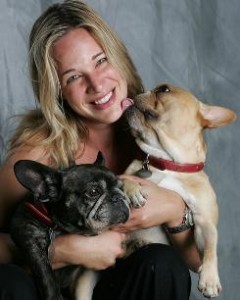
Dr. Patty Khulyx

According to a recent post in USA Today, many veterinarians have distinct opinions on what we name our animals.
“Less-than-fetching pet names can reflect back on owners,” Florida-based veterinarian Dr. Patty Khuly says that what a cat or dog is named can reveal quite a bit about the pet parent.

So what does your pet’s name say about you?

Whether it’s the twentysomething’s Rottweiler named “FUBAR” or the newlywed couple’s first kitten registered as “Emma,” veterinarians usually get the picture.

Dr. Khuly says that trends and the person’s attitude toward their pet is reflected in their name and their name reflects back on you.

“Though I may make fun, I do understand that our pets’ names are justifiably sacred. The bond we share with them gets its early start when we offer them a denomination (or epithet, as the case may be) and is constantly reinforced with each call and response.”

That’s right.  Just don’t make fun of me for having no imagination because I named our white cat…White Cat.

Linda Ferguson

Reblog this post [with Zemanta]

What if your pet gets sick, you get help..but then your pet dies anyway?

May 11th, 2010
Dog
Image by andy castro via Flickr

Every once in awhile I’ll come across something someone has written that so perfectly showcases challenges a pet parent will face one day that I don’t want to even try to give my take on it.

And that’s how I feel about this blog post that I discovered recently.  It perfectly shows what we’ll all be faced with at some time and very importantly what your vet’s responsibility in those scenarios are and what YOURS are as well.

Well written from the point of a veterinary technician, someone who sees these dramas played out on a daily basis.

————————

What if….

Scenario 1:

What if your pet was very sick and when you took them to the vet they said that they didn’t know what was wrong with him, just take him home and make him comfortable. No offer of any diagnostics whatsoever. Then your pet died.

Scenario 2:

What if your vet did offer you diagnostics? But you elected to not have them done, it doesn’t matter the reason. Then your pet died.

Which scenario is the fault of the veterinarian?

Scenario 3:

What if your vet was given permission to do the diagnostics, got an idea what could possibly be wrong but wasn’t sure without further testing, but didn’t offer it to you because the testing was quite expensive and your pet died?

Scenario 4:

What if the vet did offer to do further testing you declined and your pet died?

Which scenario is the fault of the veterinarian.

Scenario 5:

Okay, you opted for all the possible testing, the vet made a definitive diagnosis, knew of a fantastic treatment protocol that could (nothing in life is a guarantee) save your dog BUT it’s very expensive and maybe your pet would die anyway. So the vet elects to not even mention it, after all, why would anyone want to spend that kind of money on a pet? Your pet dies a week later after treatments that were much more affordable and could possibly save your pet…but doesn’t.

Scenario 6:

Same as #5 but this time the vet DOES offer you the expensive treatment that you decline due to cost. Sadly the outcome is the same as #5.

Scenario 7:

Same as #5, but this time you opt to go for the more expensive treatment and though things look pretty good at first, your pet dies anyway. 🙁

Which scenario is the fault of the veterinarian?
___________________________________

If you said; #1, #3 and #5 you would be correct.

Does that make you at fault for the others? Absolutely not!!! Sometimes, our beloved pets die, no matter how much money we throw at their problem, no matter how much we love them. It sucks, but it’s not ALL about blame.

The problem that I’m trying to outline (I never claimed to be a writer folks, LOL) is that a veterinarian is under a moral & legal obligation to offer to you every thing that he or she knows is available that may help your pet when it is ill. It’s not a financial obligation. It’s what’s right. It would be downright mean and irresponsible to not inform you of ALL of your options to help your friend and companion.

Your obligation is to do what you’re capable of doing.

Don’t feel guilty because you can’t afford a treatment out of your financial capacity, it’s okay.

I can’t afford a lot of treatments for my own pets either. It hurts like hell, but it’s the truth. We hear stories of people taking out a 2nd mortgage for cancer treatments and the like for the pets, but they’re not common. One client I know sold her car! That was what THEY chose to do, but it’s not expected, by any stretch of the imagination, for every pet owner to do so.

Don’t be shy, say no if you need to do so. Above all…don’t feel guilty. It really is OK that you can’t afford an MRI, expensive cancer treatments or thousands of dollars worth of testing.

Nancy Campbell, RVT (Registered Veterinary Technician)

———————-

Linda Ferguson

Reblog this post [with Zemanta]

A glimpse into how the FDA evaluates a pet drug

April 24th, 2010
:Original raster version: :Image:Food and Drug...
Image via Wikipedia

Did you ever wonder what the FDA’s approval and review process is for a pet drug?  I did.

Since the time of the Great Melamine Pet Food Recall of 2007, pet owners have been painfully alert to new recalls and warnings issued by the FDA, and there have been many (I just posted another one today on our Daily Paws blog, the second one in a week).

While I was researching a recent article on an FDA issued warning for flea and tick products, I came across this page on their website:

Transcript for the March 24, 2010 Veterinary Medicine Advisory Committee from March 24th, 2010, and this transcript deals with the pet product ProHeart 6, a canine heartworm preventative.

It is a fascinating and revealing look at the process that the FDA takes after it has received complaints about a particular drug or pet food on the market.

The FDA develops a RiskMAP (Risk Minimization Plans, which is a  process of assessing a product’s benefit to risk balance, developing and implementing tools to minimize its risks while preserving its benefits, evaluating tool effectiveness and reassessing the benefit-risk balance, and making adjustments as appropriate to the risk minimization tools to further improve the benefit-risk balance), for a drug and this is one of the terms that you’ll see when you visit the link above so it is good to have a grasp of what they are talking about.

If you google ProHeart 6, you’ll see that it is a product that has been controversial, both with pet owners and with some veterinarians.  I visited www.proheart6.com today and – while the site isn’t working quite right – I saw what I think the is RiskMAP for this product there.

It is well worth your time to peruse these transcripts.  See what a typical product evaluation process is and just how the FDA treats all those reports of adverse results a drug has on our pets.

It’s good to know.

Linda Ferguson

Daily Paws
VetLocator.com

Reblog this post [with Zemanta]

Home hospice and euthanasia for our pets

April 22nd, 2010

dr.turner

There is a growing trend in veterinary care – home hospice and home euthanasia for pets, and I, for one, am happy to see these services being offered on an increasing basis.  Today there was an article in our local paper about one such veterinarian in the Tampa Bay area that gives a glimpse into a ‘day in the life of a home hospice/euthanasia veterinarian’:

From the Saint Pete Times – April 19, 2010
By Alexandra Zayas, Times Staff Writer

An hour before, Dr. Dani McVety begins to prepare. “Come on, girls,” she calls to her two rat terriers, “in the crate. “You too, Foose.” A big, brown mutt settles into the third cage in McVety’s Lutz home as she shuts the door and heads out to the garage. She pulls a green scrub shirt over her head, opens her trunk and unlocks a black box to reveal liquid-filled bottles. She inserts a syringe in one and slowly extracts a pink fluid, the last she’ll use today. It’s part of a list of things she does before she gets to someone’s home, things she doesn’t want them to see. She also fills out their authorization form in advance, because she has seen how hard it is to write with shaking hands.

As a rule, she never arrives early. So she heads to Starbucks first and orders a dark cherry mocha — decaf, because she and her husband just found out she’s pregnant for the second time.

In many ways, the 28-year-old veterinarian is just starting her life. Yet on this Monday morning, the career path she has chosen takes her to a Land O’Lakes home.

To end one.

• • •

McVety is a hospice veterinarian, part of a growing movement to revolutionize the way animals die. It’s modeled after human hospice, focusing on pain and grief management and creating a comforting scenario for families and pets when the end comes.

Some veterinarians have been doing these things for the past few decades, but hospice care is only now becoming a recognized field in veterinary medicine. It’s no surprise. Pets have evolved into family members, and better medicine means they’re living longer with serious illnesses. Meanwhile, more and more people have had good experiences with human hospice.

The demand is high. McVety performs five in-home euthanasias a week. In one day this week, she had four. When she graduated from the University of Florida’s vet school last year, she never imagined this would become her job.

She grew up with horses in Odessa, wanting to become an equine veterinarian, but shifted to a different kind of pet care because she preferred the connection she felt with owners of dogs and cats. She knew losing animals came with saving them, but she dreaded her first death.

She was at the Tampa Bay Veterinary Emergency Service on Bearss Avenue when she realized she had a talent for dealing with people in pain. A woman came in at 8 p.m. with a cat that had only hours left. The woman insisted her cat could not die that day, the one-year anniversary of her last cat’s death. She said she didn’t know how she could drive home, but told McVety she wanted to leave the cat there, and asked the doctor to call when her pet was dead.

McVety told her she needed to stay. Her cat needed her. At 12:01 a.m., they put the cat to sleep. And the woman, who had the time she needed to say goodbye, was able to drive home. All she needed was for it to happen on her terms.

The doctor saw herself in the grieving pet owners who walked into the clinic night after night. She was a year or two into college when her childhood dog, Dusty, developed such severe arthritis she couldn’t stand. The family had to pick up the 80-pound Doberman, put her in the car and unload her at the clinic. McVety already had enough medical knowledge to know how much pain that caused Dusty.

She remembers walking into the waiting room and having to pass a bouncing puppy. Seeing the doctor for two or three minutes. Wishing she could hold her dog, but not being able to because of where the IV was placed.

Wanting to rip the tube out of her dog’s leg once it was over.

In August, she started a hospice practice. She settled on a name after watching a chihuahua die curled up in a woman’s lap.

She called it Lap of Love.

• • •

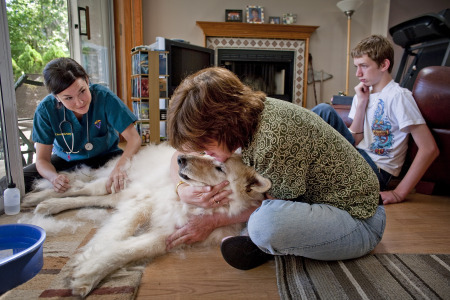
McVety runs her hand through the thick white fur of a German shepherd sprawled by the sliding glass door of a lakefront Pasco County home.

“He’s gorgeous,” McVety says.

His name is Rudy. He is 14 years old. He has arthritis, bad hips and tumors throughout his body. His hearing and sight have faded and he can’t stand up or hold his bladder. His family — Judy Turner, her husband and their 14-year-old son, Jacob — scheduled this visit weeks ago to fall on spring break.

They feel like they’ve waited too long.

They tell McVety about Rudy, the way he used to dip his paws in the swimming pool, as if he were soaking his nails. The way he used to squeeze out of the yard when they were gone, but return just before they got home. The way he wouldn’t go into the house before each one of them was inside, safe.

“He’s as old as I am in human years,” Jacob says. When they first met, he was a baby, and Rudy was a puppy.

McVety asks what they’d like inscribed on the box that will hold his cremains. Judy Turner begins to cry.

“My big old polar bear,” she says.

Turner finds her place on the floor, just over Rudy’s head. She leans over and rubs his belly.

“Yeah,” she tells him, “give us a grunt. Yeah, yeah, you’re a big old polar bear … “

McVety explains that the first injection will be a sedative. It startles Rudy, who gets restless. Turner holds him tight.

“That’s your back yard out there,” Turner says. “Look at that, chasing all those balls out there, bringing them back. You’re a good boy.”

Rudy slows down, his gaze fixed outside. The sky is a bright blue. Leaves swirl in the swimming pool. He begins to fall asleep.

McVety shaves a patch in one of his hind legs. It reminds Jacob of the time his dad cut Rudy a lion’s mane, and the time they sculpted his fur to look like a poodle.

“You sleepy, Rudy?” Turner asks. “You fallin’ asleep on me?”

It’s time.

“Please stop me if you don’t want to hear this,” McVety says. “The drug we use is sodium pentobarbital. It’s a drug overdose of pain medication. It’s very painless. It affects the brain before it affects the heart …

“I think he’s ready,” McVety says.

The last time the Turners put a dog to sleep, Jacob was a baby and Judy had to step out of the room to tend to him. By the time she returned, the dog was gone. The doctor hadn’t told them what was going to happen before it already had.

Turner answers, “I think he’s ready, too.”

Jacob stares at the pink fluid flowing into his dog as Turner keeps talking.

“You’re okay, buddy boy. You’re just fine. You always do things well … “

Rudy breathes deep.

“You’re such a dignified creature. Look at how dignified you are.”

He’s still.

“So well done, Rudy. So well done … “

McVety whispers, “He’s gone.”

• • •

(To read the rest of the article, click HERE.)

To find out more about home euthanasia and to locate a veterinarian in your area that provides this service, visit VetLocator.com and enter your zip into our Quick Search directory and click Search.  On the left of the page click on Advanced and select Home Euthanasia, then scroll to the bottom and enter your zip again.

Warmly,
linda-sig
Daily Paws
www.vetlocator.com

Recall Alert: Purina horse feed and poultry feed recall

April 21st, 2010

purina_logo

Purina Mills is voluntarily recalling two types of feed because of metal fragments found in the mixes.  There have been some complaints but no reports of injury or damage to animals has been reported yet.

Below is the FDA’s recall:

Purina Mills Undertakes Limited Recall of Strategy® Horse Feed and Layena® Poultry Feed

Contact:
Jeanne Forbis: 651-481-2071 or 612-308-5441
David Karpinski: 651-481-2360

Products Distributed in Mississippi, Arkansas, Kentucky,Tennessee, Alabama, Indiana, Missouri and Virginia

FOR IMMEDIATE RELEASE — St. Louis, Mo., April 16, 2010 — Purina Mills, LLC, is voluntarily recalling two specific lots of 50-pound bags of Strategy® Professional Formula GX horse feed and one lot of Layena® SunFresh® Recipe Pellet poultry feed. The recall is being implemented due to the discovery of metal fragments in a limited number of bags from one of the Strategy® product lots. At the time the recall was issued, five customer complaints had been received. No animal health issues had been reported.

The products being recalled were manufactured in Nashville, Tennessee, on March 24-25, 2010. They were shipped to retailers and dealers in Mississippi, Arkansas, Alabama, Tennessee, Kentucky, Indiana, Missouri and Virginia.

Only the following specific products and lot numbers are involved in the recall:

Formula No. Item No. Description Lot Number
35SS 0066547 Strategy® Professional Formula GX 0MAR24NST1A1
35SS 0066547 Strategy® Professional Formula GX 0MAR24NST2A1
61R3 0056922 Layena® SunFresh® Recipe Pellet 0MAR25NST2A1

The lot number is found on the sewing strip of each bag and is interpreted as follows:
0=Year / MAR=Month / 24=Day of Month / NST1A1=Plant Code.

Customers with products that do not have the specified lot numbers are not affected by the recall.

Customers who have purchased the recalled products should not store or feed the products and are asked to return unused product to their dealer for replacement.

Customer questions or concerns may be directed to the company’s Nashville Customer Service Office at 800-424-5234.

Reblog this post [with Zemanta]